
A Practical Guide to Attachment Patterns in Adulthood
Find Out Your Attachment Style
Get StartedUnderstanding How Attachment Shapes Grown-Up Bonds
Romantic connection, trust, and emotional safety do not emerge randomly; they are influenced by inner maps that formed through caregiving, life events, and repeated interpersonal feedback. Those internal maps guide how people seek closeness, handle conflict, and repair after misunderstandings. Rather than being destiny, these tendencies are best viewed as learned strategies that can be tuned over time. With curiosity, language for nuance, and a little structure, anyone can examine patterns and make intentional adjustments that serve healthier intimacy.
Contemporary clinicians tend to treat these tendencies as dynamic processes rather than fixed labels. Grounded in decades of research, models like adult attachment theory have organized the ways people regulate proximity, interpret partner signals, and navigate vulnerability in everyday life. This framework links early experiences to present-day expectations without reducing a person to a category.
When people explore their interpersonal patterns, clarity often replaces confusion and blame. In practice settings, taxonomies described as adult attachment styles help therapists and coaches craft precise goals, choose effective interventions, and track progress toward secure functioning. By naming the pattern, partners can coordinate around needs for reassurance, autonomy, and repair after ruptures.
- Patterns influence how quickly someone bids for closeness.
- They shape interpretations of silence, lateness, and conflict.
- They guide whether reassurance is requested directly or indirectly.
Why Knowing Your Pattern Improves Well-being and Love
Self-knowledge reduces guesswork in dating, partnership, and co-parenting. People who understand their triggers can communicate needs without escalation, while also extending empathy to a partner’s sensitivities. This awareness often trims unnecessary anxiety and shortens arguments because it reframes what looks like rejection into a manageable nervous-system response. Over time, couples move from reactivity to collaboration as they practice co-regulation and clear agreements.
Clarity about one’s tendencies can sharpen goals for personal growth. Many find that labeling their specific subset of behaviors as an adult attachment style turns vague dissatisfaction into targeted experiments with boundaries, bids for attention, and repair rituals that actually work. Specific language makes it easier to ask for help and to measure whether interventions are delivering relief.
Relationship satisfaction improves when both people share a common map of intimacy. In day-to-day life, understanding the landscape referred to as attachment styles in adult relationships allows partners to anticipate stress points, normalize differences, and design routines that foster security. With predictable rituals, even historically tense moments become opportunities to build trust rather than evidence of incompatibility.
- Greater emotional granularity leads to fewer misunderstandings.
- Shared vocabulary makes negotiation faster and kinder.
- Aligned repair strategies turn conflict into connection.
The Four Core Patterns Explained and Compared
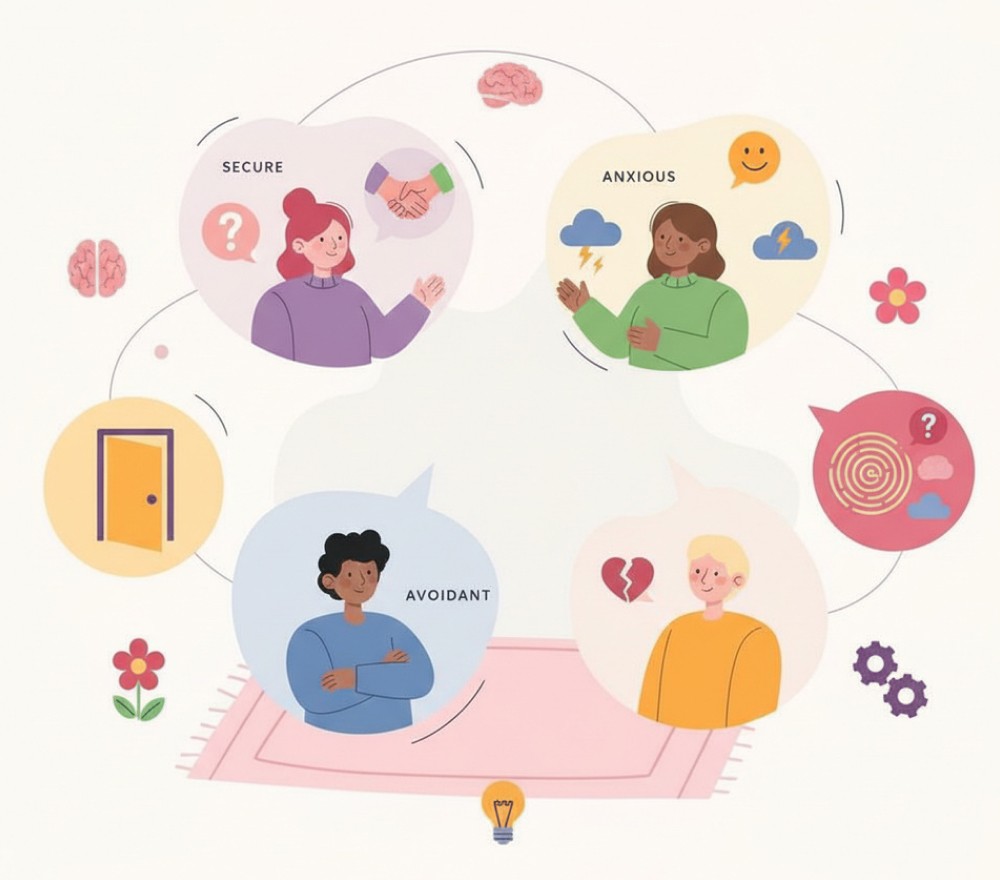
Across cultures, researchers consistently observe clusters of beliefs and behaviors about closeness, autonomy, and caregiving. One cluster reflects flexibility and comfort with intimacy; others lean toward hypervigilance, self-reliance, or fluctuation between the two. Although labels help us talk about patterns, people are more nuanced than categories, and they may flex across contexts such as work, friendship, and romance. What matters most is how well a strategy maintains connection under stress.
| Style | Core Beliefs | Typical Triggers | Growth Moves | Relationship Upsides |
|---|---|---|---|---|
| Secure | “I am worthy, and others are dependable.” | Major breaches of trust | Name needs, co-create rituals, maintain boundaries | Stable intimacy, resilient repair |
| Preoccupied | “Connection feels uncertain unless proven.” | Delayed replies, ambiguity | Self-soothing, clear asks, paced checking | High attunement, emotional insight |
| Dismissing | “Independence protects me from hurt.” | Intense demands, loss of control | Gradual openness, shared routines, repair steps | Calm presence, steadiness under pressure |
| Fearful | “Closeness and distance both feel risky.” | Inconsistency, conflict spikes | Therapeutic support, titrated intimacy, safety plans | Empathy for nuance, capacity for depth |
While categories are shorthand, development continues across the lifespan with supportive experiences and intentional practice. Many readers appreciate having a concise map because it turns a swirl of reactions into something workable. In discussions and workshops, people often cite the clarity they gain from a compact summary of the 4 adult attachment styles when they are trying to decode recurring conflicts.
Clinicians frequently rely on validated frameworks to ensure their impressions are anchored in evidence rather than hunches. In case formulation, reference tools such as the adult attachment inventory provide shared language for teams, helping align treatment targets with measurable outcomes. With reliable anchors, progress can be tracked over months rather than guessed at week to week.
From Insight to Action: Self-Reflection and Assessment
Awareness becomes transformative when it is woven into daily habits. The first step is observation: notice what happens in your body and thoughts when intimacy feels uncertain. The second step is translation: convert reactions into needs that can be spoken aloud. Finally, practice repair early and often so that missteps do not calcify into narratives of incompatibility. Small, repeated behaviors outcompete sporadic grand gestures.
People who like structure may benefit from guided measurement, especially at the start of their journey. For personal tracking, tools labeled an adult attachment style assessment can organize reflections into tangible patterns, which supports clear conversation with a partner or therapist about experiments to try next. Data-informed reflection tends to reduce shame because it normalizes common reactions under stress.
- Journal after conflicts to capture triggers and bodily cues.
- Design tiny, repeatable bids for closeness each day.
- Schedule repairs within 24 hours to prevent the distance from widening.
- Practice nervous-system downshifts before tough conversations.
When comparing options, it helps to choose instruments that report reliability and offer actionable feedback. For couples or groups, a structured process described as an adult attachment styles assessment may reveal interaction patterns that individual reflection misses, enabling collaborative solutions. The point is not to collect labels but to guide behavior toward greater safety and connection.
Evidence-Based Tools and How to Use Them Wisely
Not all instruments are equal, and more items do not automatically mean better insight. The most useful tools translate scores into plain-language summaries with next steps you can practice immediately. When looking at measurement, treat results as a snapshot of tendencies under certain conditions rather than as permanent identity markers. Re-testing after intentional practice can show meaningful shifts.
Some readers prefer shorter formats with clear, actionable prompts. In that case, you might explore a brief measure such as an adult attachment style questionnaire because it can spotlight dominant tendencies without overwhelming you with jargon. Short forms are convenient for check-ins across time as you experiment with new behaviors.
Others want longer instruments and richer narrative feedback to support therapy. For those needs, practitioners often reference an adult attachment questionnaire that reports multiple dimensions, including comfort with closeness, trust, and autonomy, which helps tailor exercises. Detailed feedback can be particularly helpful when partners are building new rituals of connection together.
- Look for clear scoring rubrics and norm references.
- Prefer feedback that includes concrete practice suggestions.
- Retest on a consistent schedule to observe change.
Quizzes, Micro-Practices, and Building Security Every Day
Learning about your relational habits is one step; embodying new responses is where growth compounds. Micro-practices, like naming one feeling before problem-solving, or requesting a five-minute check-in at set times, shift interactions toward safety. As partners become reliable sources of calm, nervous systems settle, and formerly explosive moments turn into predictable dance steps that both people can navigate.
For a light-touch doorway into self-knowledge, some people start with a brief check like an adult attachment style quiz because it lowers the barrier to reflection and creates talking points for a supportive conversation. The key is to treat any result as a starting hypothesis rather than a verdict, then to test that hypothesis with real-world experiments.
If you prefer variety and repeated self-checks, rotating through a simple tool like an adult attachment quiz can keep insights fresh while you practice new scripts for reassurance, boundary-setting, and repair. Over time, the combination of small assessments and daily exercises tends to produce a steadier baseline of trust and responsiveness.
- Pair quick check-ins with a calming breath sequence.
- Use a shared calendar for connection rituals you both protect.
- Write brief appreciation notes after tough conversations.
- Celebrate micro-wins to reinforce secure behaviors.
FAQ: Common Questions About Attachment in Adulthood
Can someone change long-standing patterns of closeness and distance?
Yes, these strategies are adaptive and can evolve with consistent practice, corrective emotional experiences, and supportive relationships. Therapeutic work, secure friendships, and compassionate self-talk build new neural expectations over time.
How do stress and life transitions affect these tendencies?
Under load, like job loss, illness, or parenthood, people often revert to default strategies. Planning predictable rituals of connection and repair cushions those shocks and maintains a sense of safety during change.
Is it useful to label a partner, or can that backfire?
Labels are best used as communication tools rather than verdicts. They help explain reactions and guide helpful responses, but they should never be wielded as weapons or excuses to stop growing together.
What signs suggest someone is moving toward greater security?
Look for faster repair after disagreements, clearer requests for comfort, balanced independence, and a growing ability to self-soothe while remaining emotionally available to a partner.
Do different contexts bring out different patterns?
Absolutely, many people show more flexibility with friends than in romance, or vice versa. Context, history, and current stress levels interact, so it’s wise to track patterns across settings before drawing firm conclusions.